


Waking up with frizz, tangles, flattened curls, or a hairstyle that needs to be redone can make your morning routine unnecessarily complicated. While you sleep, your hair moves against the pillow and may become tangled, dry-looking, or misshapen—especially if it is curly, long, color-treated, or already styled.
Wrapping your hair in a silk scarf helps keep it contained and creates a smoother layer between your hair and the bedding. This may reduce overnight friction, preserve curls or a blowout, and make your hair easier to manage the next morning.
The results, however, depend on how you secure the scarf. Tie it too loosely and it may slip off; tie it too tightly and it can leave marks or feel uncomfortable. In this guide, you will learn how to tie a silk scarf on your head to sleep, adapt the method to your hair type, and keep the scarf secure without unnecessary pressure.
Table of Contents
- What You Need Before Wrapping Your Hair
- How to Tie a Silk Scarf on Your Head to Sleep: The Basic Triangle Wrap
- How to Adapt the Wrap to Your Hair Type
- How to Keep a Silk Scarf From Slipping Off at Night
- What Size Silk Scarf Is Best for Sleeping?
- A Better Wrap Comes From Fit, Not Force
- Frequently Asked Questions
What You Need Before Wrapping Your Hair
Prepare the following before bed:
- A square silk scarf large enough to cover your hair, preferably 100% mulberry silk scarf
- A wide-tooth comb or gentle brush
- An optional silk scrunchie for long or curly hair
- Any lightweight leave-in product already used in your routine
Begin with silk worthy of an all-night ritual. Mulberry silk is a natural protein fiber containing rich amino acids, with an exceptionally smooth surface that reduces friction, frizz, and tangles. MANITO pairs this refined material with OEKO-TEX® STANDARD 100 certification, confirming that its silk has been tested for harmful substances and is suitable for prolonged contact with your hair and skin.
Your hair should generally be dry before you cover it for the night. Wet hair is more vulnerable to stretching and breakage, while moisture trapped under a wrap can also feel uncomfortable. If you wash your hair in the evening, allow it to dry before tying the scarf.
Avoid applying a heavy layer of oil immediately before wrapping. Too much product can make the scarf slide and may transfer onto the silk.
How to Tie a Silk Scarf on Your Head to Sleep: The Basic Triangle Wrap
This method works well for many hair types and is an easy place for beginners to start.
1. Prepare your hair
Gently detangle your hair and arrange it in the shape you want to preserve.
Straight or fine hair can be brushed smoothly around the head or gathered into a very loose low style. Long, wavy or curly hair can be lifted toward the crown in a loose pineapple. Braids and twists should be arranged so that you are not lying directly on a bulky section.
If you need to gather your hair first, use a soft silk scrunchie rather than a narrow conventional elastic. Loop it only as many times as needed to hold the hair without pulling at the roots.
2. Fold the scarf into a triangle
Lay the scarf flat and bring one corner diagonally across to meet the opposite corner. You should now have one long folded edge and one pointed end.
If the scarf feels too large, fold the long edge inward once before placing it on your head. Keep this fold flat; a rolled or bunched edge is more likely to create pressure across the hairline.
3. Place the scarf at the nape
Lean forward slightly and position the long folded edge at the nape of your neck. The triangle should extend over your hair toward the front of your head.
Center the scarf before tying it. Uneven ends usually lead to uneven tension, which makes one side loosen during the night.
4. Bring the corners to the front
Take the two side corners and bring them forward above your ears. Cross them over the pointed corner near the center of your forehead.
Tie the side corners once, then make a small second knot if the fabric needs it. The knot should feel stable, not tight. You should be able to move your eyebrows and slide a fingertip under the front edge comfortably.
Back sleepers usually prefer a small knot near the forehead or slightly to one side, while side sleepers should keep it away from the side resting on the pillow. Avoid placing a bulky knot at the nape, where it can press against the head and loosen as you move.
5. Tuck in the loose fabric
Lift the pointed corner back over the knot or tuck it underneath the crossed ends. Smooth any loose edges around the sides and check that your hair is fully contained.
Turn your head from side to side and lie down for a few seconds. If the scarf shifts, first adjust its position and flatten the edges. Do not immediately solve every movement problem by pulling the knot tighter.
How to Adapt the Wrap to Your Hair Type
For curly, coily or voluminous hair
Gather your curls loosely near the top of your head so you do not sleep directly on them. This is commonly called the pineapple method. Keep the base loose to avoid stretching the curl pattern or flattening the roots.
Place the long edge of the scarf at the nape and create a roomy pocket for the curls rather than pressing them flat. Bring the corners forward, tie them above the forehead and tuck the remaining fabric around the hair.
A MANITO Macaron Large Silk Scrunchie can help hold a loose pineapple before wrapping. It is made from 22-momme mulberry silk charmeuse, so it keeps the silk-on-silk routine consistent without requiring a tight elastic.
For straight or fine hair
For smoother straight hair in the morning, brush your hair around the shape of your head in one direction. Secure the ends gently if necessary, then place the folded edge of the scarf across the hairline and wrap the triangle over the back.
Keep every layer flat. Thick folds, clips and bulky knots can leave unwanted bends in fine or straight hair.
For long hair
Do not force long hair into a tight bun. Try a loose braid, a high pineapple or a gentle circular wrap around the head. The scarf must be large enough to contain the full length without pulling at the scalp.
If your ends escape during the night, tuck them into the center of the wrap before making the final knot.
How to Keep a Silk Scarf From Slipping Off at Night
Slipping is the most common frustration, but tighter is not always better. An excessively tight scarf can move backward as your head turns and may cause discomfort around the hairline.
For a more secure fit:
- Start with the scarf centered and both ends the same length.
- Keep the front edge flat rather than rolled.
- Place it at or just in front of the hairline.
- Experiment with covering the tops of your ears if the scarf moves upward.
- Position most of your hair away from the nape.
- Tie a small, flat knot rather than a large bow.
- Tuck in loose corners that could catch on the pillow.
- Move the knot slightly to the front or side if you sleep on your back.
- Pair the wrap with a smooth silk pillowcase to reduce the pulling force on the scarf.
A MANITO silk pillowcase can serve as a useful backup for active sleepers. If the scarf shifts during the night, your hair still rests against a smooth silk surface.
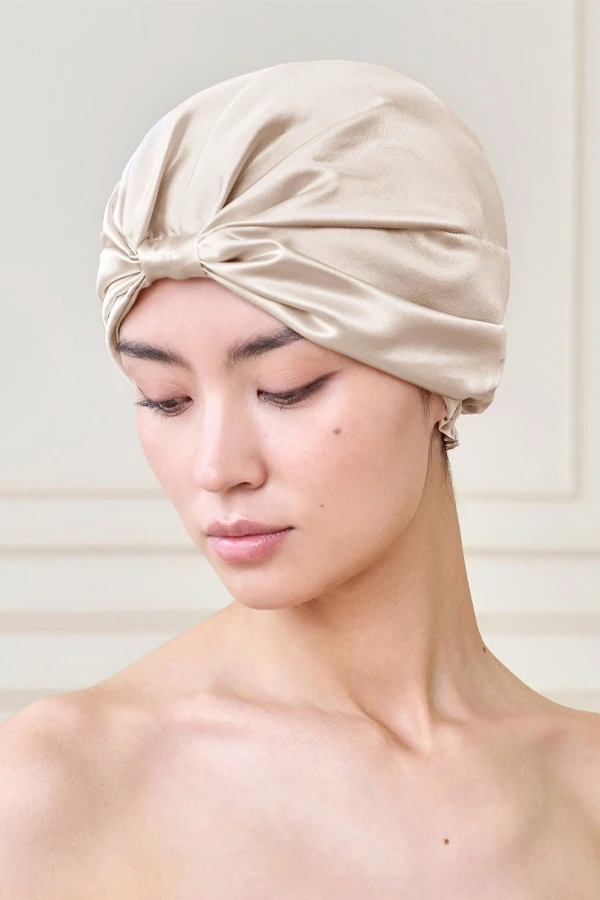
Avoid sleeping on bulky pins or clips. Although they can hold a scarf in place, they may press into the scalp or catch hair when you turn. If you prefer full hair coverage without tying a scarf, MANITO Blooming Women’s Silk Sleep Cap offers another option in smooth mulberry silk.
What Size Silk Scarf Is Best for Sleeping?
For a full triangle wrap, a square scarf between 27 and 35 inches (approximately 70–90 cm) is the most practical starting point. The best size depends primarily on your hair’s length and volume—not simply the circumference of your head.
- 20–22 inches (50–55 cm): Better suited to headbands, partial coverage or very short hair than a full overnight wrap.
- 25–28 inches (64–71 cm): Usually sufficient for short, fine or lower-volume hair and simple wrapping styles.
- 34–35 inches (86–90 cm): Offers more room for long, thick, curly or coily hair, braids and a loose pineapple.
To check the fit, fold the scarf diagonally and place the long edge at your nape. The two ends should reach comfortably around your head with enough fabric for a small, flat knot, while the pointed section should cover your hair without compressing it. If hair escapes or the scarf can only be secured by pulling tightly, choose a larger size.
A Better Wrap Comes From Fit, Not Force
Learning how to tie a silk scarf on your head to sleep may take two or three attempts. Begin with the triangle wrap, then adjust the hair placement, knot position and coverage based on what you notice in the morning.
If it slipped, flatten the edge or reposition the hair before tightening it. If your curls looked compressed, create more room at the crown. If the knot felt uncomfortable, move it away from the part of your head that rests on the pillow.
The right wrap should feel secure enough to protect your hairstyle—and comfortable enough that you can forget about it and sleep.
Frequently Asked Questions
How tight should a silk scarf be for sleeping?
It should remain in place when you turn your head but should not cause pulling, throbbing or a visible pressure line. If tighter tying is the only way to keep it on, change the scarf position or hair arrangement instead.
Should the knot be at the front or back?
A front knot often works well for back sleepers because it keeps bulk away from the pillow. Side sleepers may prefer the knot near the forehead or slightly toward the opposite side. Choose the position that does not sit directly beneath your head.
Should the scarf cover your ears?
It is optional. Covering the upper part of the ears can provide more stability, but some people find it uncomfortable. Try both positions and prioritize a secure fit without pressure.
Can you sleep with wet hair in a silk scarf?
It is better to let your hair dry first. Wet hair is more fragile, and covering it may prevent comfortable drying or alter the intended hairstyle.
Can you wear a silk scarf every night?
Yes, provided the wrap is clean, comfortable and not tied tightly. Rotate or wash your scarf according to its care instructions, especially if you use oils or leave-in products.
Can You Sleep in a Silk Headband?
Yes, you can sleep in a silk headband if you mainly want to keep bangs, short layers or hair around the face in place. Choose a wide, flat headband that fits comfortably without pressing into the hairline. However, a headband only covers a small section of the hair, so it cannot preserve curls, contain long hair or protect the ends as fully as a silk scarf.
